

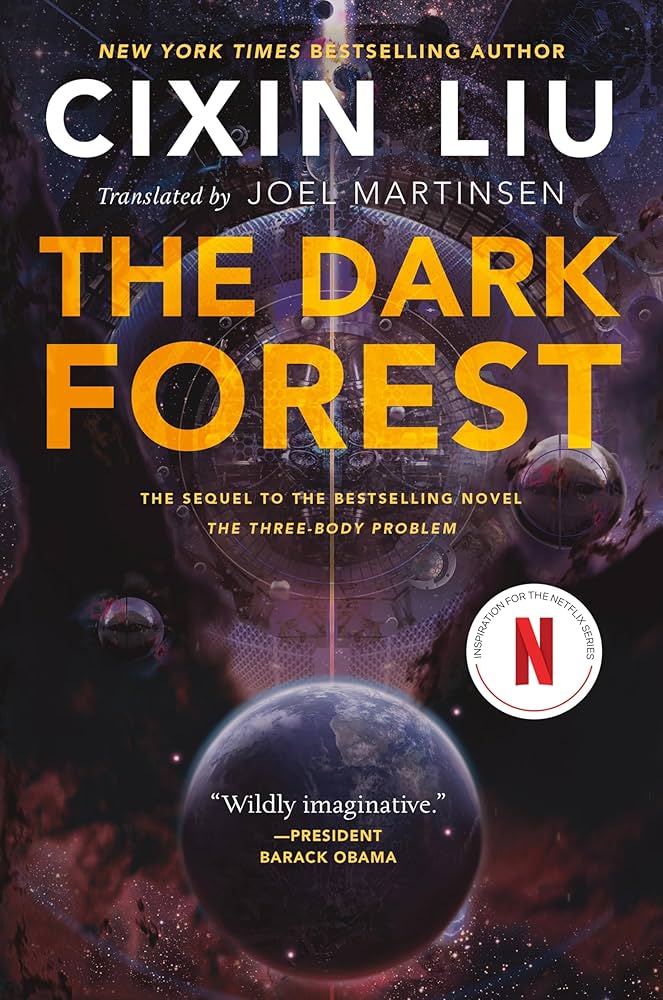
The sequel to The Three Body Problem.
This book is significantly longer than The Three Body Problem. It also answers some questions about the Netflix show’s plotlines. The first book, The Three Body Problem, does not send anyone’s brain into space at 10% the speed of light using a series of nuclear explosions and an enormous lightweight sail to propel it, as the tv series does. This occurs in the latter book. The show does a pretty faithful job of telling the story, but does so somewhat out of sequence with the books. I do not fault the show writers on this, because the books tell the story out of sequence at some points to follow the perspective of one character and then goes to another character’s perspective at the beginning of the first character’s story timeline. This, coupled with the Chinese names of many of the characters, produces a little bit of confusion for readers of the English version of this book. When I mention names like, Ye Wenjie, Shi Qiang, Ding Yi, Zhuang Yan, and Luo Ji do you get a sense of whether these character names represent a male or a female? I don’t. I find myself looking for a his or her somewhere on the pages to give me perspective. Sometimes it takes a few pages to create a mental image of what the author is conveying with a character because of this gender confusion.
The TV series makes several of the Asian characters non-Asian, and changes most of the character names completely. Watching the show did help my brain associate the characters in the book with each character’s role in the story better. The book itself comes with a legend of characters in the beginning to help the reader keep track. There are quite a few characters, too, which compounds things a little more. Most great stories only have a handful of main characters. This book has at least twice that many. The story, however, is so good, that you find yourself powering through confusing sections with the assumption that things will come together at some point. This book is comprised entirely of 80-100 page chapters. It is kind of odd to see such a change in writing style from the same author from one book in a series to the next. This book does have a different translator than the first, so maybe this accounts for it?
One of the most significant events in The Dark Forest is the arrival of a Trisolarian probe ahead of the rest of the Trisolarian fleet. The probe is rather small, somewhere around compact car-sized, and resembles a shiny metallic teardrop. It travels at a significant percentage of the speed of light and maneuvers like a hummingbird. Initially, the Earth’s fleet of starships intercepts the probe and brings it aboard one of their ships to analyze it. Even under an electron tunneling microscope, the probe’s surface looks smooth and reflective. Typically, nothing looks smooth at that magnification. The first people to examine the probe assume that it is a beautiful gift, that is, until it suddenly accelerates through the hull of the ship it is aboard. It then systematically drives through nearly the entirety of Earth’s fleet, destroying all but a handful of the fleeing starships before stationing itself between the Earth and its sun.
At this point, it is clear that the Trisolarians are a threat to humanity and that they have a technological advantage that appears insurmountable. A wallfacer named Luo Ji, Saul Durand in the show, devises a way to basically destroy the entirety of Earth’s solar system with strategically placed nuclear warheads in space.

Luo Ji is Saul Durand, played by actor Jovan Adepo in the Netflix Series.
Luo Ji’s vital signs are linked to devices that will set off these warheads if his life ends. He threatens to kill himself if the Trisolarians do not form a truce with the people of Earth. This planned threat of mutually assured destruction largely works, as the Trisolarians agree to share some of their technology and release the sophon’s restrictions on life on Earth. At this point, it appears like the book series could end, but an even longer sequel, Death’s End, follows.
One thing this book does is answer the question of the Fermi Paradox. The Fermi Paradox basically says that if the universe is infinitely large and there are an infinite number of universes, then the likelihood of aliens existing should be a certainty, so why have we not seen any? The answer presented in this book is that, once one planet’s higher life forms signals its existence to that of another planet, the life form with the lower level of technology will eventually be exploited and or driven out of existence. Basically, the same thing that happened many times on Earth when one advanced civilization found a less advanced one during the 1200’s to the 1800’s via sailing ships, rather than space ships.