

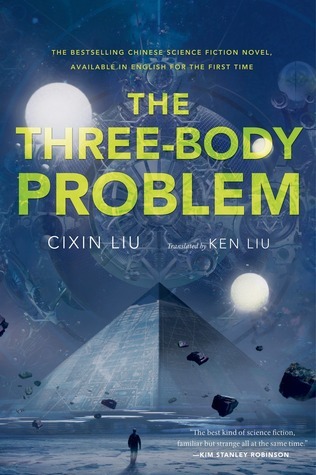
Three Body Problem

It has been several years now, but, long ago, I asked my former co-worker, Danny Smyth, if he had any book recommendations. This was it. I wish I had picked it up sooner.

While I started reading it on a recent flight to Harrisburg, PA, the gentleman next to me asked whether this was the book that the tv series was based? I told him that I was not aware of it being a series. We gave each other some context of the plot and I learned that this is currently a Netflix series. After I finished the book, I watched the first episode.

The tv series omits a very brutal and graphic execution of a female student protester that opens the book. The story does not seem to suffer from the omission as the opening of the series is still fairly brutal without it, as it portrays a physics professor beaten to death on a stage, in front of a large student crowd for teaching Western theories, namely Einstein’s theory of relativity. On the stage with the professor is his wife, who appears to go along with the crowd for the sake of her own preservation.  The professor’s daughter is also an unwilling witness in the crowd. The opening chapters start in 1966 during a cultural revolution that reviles all Western teaching and thought, regardless of whether or not it is correct.

The professor’s daughter, Ye, is the closest thing to a main character in this book. She is initially imprisoned for her association with her father, but is then given the opportunity to work for a secret military complex using her scientific background. The catch is that she must agree to spend her life there. She accepts without hesitation, to the surprise of everyone involved. After initially being told that the military complex is working on technology to disrupt and destroy enemy satellites, she later finds that the real purpose is to contact and communicate with whatever intelligent life might be out in space on distant worlds.

Many years go by without any such communication, and then one day a message appears from a civilization on a planet called Trisolaris. This message is followed by another one instructing whoever read the message not to respond, because it will result in earth being invaded and taken over by the civilization on Trisolaris. Ye, despondent with the state of mankind and civilization in general, does respond, aiming her signal directly at the sun to amplify it. She sends a short message stating she would assist the aliens as mankind is unable to solve its own problems. The response to the message will give the aliens a location, based on the delay in receiving it. The distance is 4.2 light-years. Even in a very fast ship, it will take the aliens 450 years to arrive.

The aliens know that their technology is far superior to that of humans, but determine that by the time they reach earth to overthrow it, earth will likely have surpassed them because Trisolaris developed, due to their having three suns, with alternating stable and chaotic eras. During chaotic eras, they could not progress. The chaotic eras existed when multiple suns appeared simultaneously and created extreme heat and/or gravitational pull, or when none appeared for a long time and created extensive freezes. The Trisolarians would dehydrate before a chaotic era, to be rolled up and stored, and then rehydrated when the era again becomes stable. Someone would always have to be holed up in a protective structure for the chaotic eras to rehydrate the rest when the era ended. We discover this through the characters in the book playing a simulated reality game that appears to interface with the nervous system of the player and takes over all of the player’s five senses to immerse them in the game that simulate life on Trisolaris. In the book, the interface is a full suit. In the tv series it is a shiny, metal, partial helmet. Because earth is mostly stable, it progresses largely unabated, technologically, by natural disturbances.

To maintain their technological superiority for the 450 years they must travel, they create a plan to disrupt scientific evolution on earth. They take two entangled pairs of protons, enlarge them to planetary proportions by dimensionally unfolding them, create sophisticated circuits within them, and then fold them back to proton size. Having little mass, this allows two of them to be propelled at close to the speed of light toward earth. Keeping the entangled twin of each allows instantaneous communication and control at any distance. They use these sophisticated proton-housed devices to disrupt particle accelerators on earth. They also use them to control, communicate, and monitor almost everything on earth when the protons arrive. They communicate and utilize the group of humans that are now part of a militant religious group that sees the aliens as their Gods. The group assists in disrupting technological progress on Earth.

Counter to this militant religious group is a covert organization that is linked to many of the world’s governments. It is a small, but powerful group whose grunt work is largely carried out by a gruff, former police officer.

The book ends with scientists dying en masse, science itself in chaos, and aliens enroute to take over. When I bought this book, I had no idea there were two large sequels already written. I started reading the Sirens of Titan in the interim, but I now have the sequels. I must find out the fate of humanity.
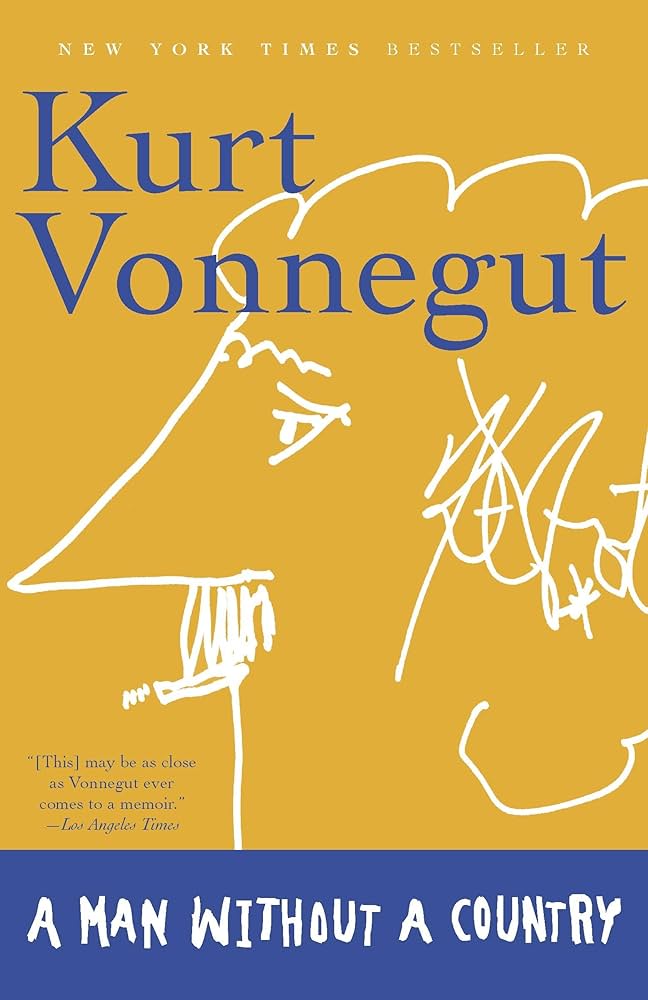
A Man Without a Country

Kurt Vonnegut is my favorite author. Slaughterhouse Five, Player Piano, Breakfast of Champions, Cat’s Cradle, and Hocus Pocus are all great novels that expertly blend science fiction, drama, and humor. This book is a little bit of a departure from his typical book. It is the last book he wrote. He passed away in 2007 at age 84 and this book was released in 2005.  This book does not really tell a story, but serves more of guide to what he was thinking when he wrote some of his famous novels as well as his current view of the world and humanity.

He mentions the politicians and political events of the time the book was written. George Bush was president and Dick Cheney was vice-president as the US attacked Iraq searching for “Weapons of Mass Destruction.” This definitely was a low point in US history. Vonnegut seems somewhat despondent at the state of events at the time. He appeared to believe that the attack was merely to gain access to Iraqi oil. This may or may not have been true. He spoke of the unsustainability of our reliance on oil, which is true. Much of what we do now, twenty years later, is even more unsustainable. Think about this, nearly six billion people own cell phones right now. How many people use the same cell phone for more than five years? Not many. We are discarding billions of cell phones every year. Where are they going? This is not sustainable and no one seems to care. We, as a society, devour vast amounts of resources for almost no reason. Nothing is meant to last. Almost nothing electronic is intended to be repaired. We just toss it. All the resources used to manufacture and transport the product are gone and all that is left is waste that does not degrade.

Vonnegut seems as he had nearly reached full curmudgeon stage as he wrote this book. He always like to poke fun at humanity’s flaws, but it seems like things had finally gone past the point of joking for him. It was more like venting. He was definitely right to be worried. This book was written 20 years ago and things have only gotten worse. The world is more disposable than ever before.

Vonnegut also seemed concerned, as he did in Player Piano, of the role computers were taking in the workforce. He was concerned of people being displaced by machines in the workforce. As AI begins to become more commonplace, this will likely become a very real issue for the generation that is currently reaching adulthood. Vonnegut predicted a universal basic income to pay a large part of humanity that served no useful purpose in Player Piano in 1952. He predicted a world largely manned by a machine workforce, with just a small number of engineers and technicians keeping it running. The rest of the world spends its days drunk in bars and wallowing in lethargy, desperately seeking meaning. Is this where we are headed?

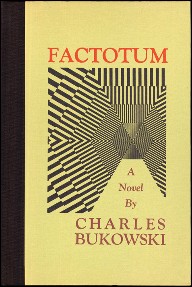
Factotum

Another Charles Bukowski novel starring Bukowski’s alter-ego, Henry Chinaski. It follows Chinaski during the 1940’s as he wanders from meaningless job to meaningless job in a drunken stupor, sometimes moving, via Greyhound bus, from his base in Los Angeles to New York and Miami. His girlfriend and sometimes prostitute, Jan, enters and leaves his life a couple of times along the way. Hank, as he often refers to himself, never maintains employment for more than a few months. He is riddled with vices – alcoholism, infidelity, gambling, and sloth. He acknowledges that he is not the greatest person. He often pokes fun at himself. Most of the humor in this book is derived from this. He sees himself exactly as society likely does – as a degenerate lacking all self-control. He is clearly able to identify right and wrong and he is also very accepting of the consequences of his wrong choices. He never seems to hold ill-will over the person firing him. Most people do not have an accurate perception of themselves. They believe they are better, smarter, or nicer than they really are. Hank sees himself precisely as an outsider would. I think it is a big part of what makes Bukowski’s writing so unique, that and the fact that he brings you vividly into his myriad of debaucherous circumstances. He makes no apologies for anything. He just expertly narrates his life at the bottom.
Here is an example of how Hank approaches a new job:

I wasn’t very good. My idea was to wander about doing nothing, always avoiding the boss, and avoiding the stoolies who might report to the boss. I wasn’t all that clever. It was more instinct than anything else. I always started a job with the feeling that I’d soon quit or be fired, and this gave me a relaxed manner that was mistaken for intelligence or some secret power.

Hank frequently works with other degenerates and bums. One thing that likely distinguishes him from the other rabble is that Hank did study journalism at city college for two years. This is a fact he often omits in his dealings with others in his circle as he believes it may disqualify him from some of the menial jobs he applies for or alienate him from the those he has to work with. Hank continuously writes and submits stories to various publications during his debauchery. This is his most redeeming quality. He is looking to improve his position through this means, despite avoiding every other aspect of being a responsible and respectable adult. He eventually gets some work published in a magazine and takes great pride in it. Bukowski himself, had his first succesful book published when he was over 50. It is somewhat endearing that he maintained a love for writing and a confidence in himself despite decades of obscurity and rejection. This is remarkable as he is considered as quite a successful author.

The book ends with Hank broke, just fired, drunk, and in a strip joint. He finds himself much the way the story starts, but now he is without his girlfriend Jan, who has found a cash cow to live with.