The sequel to The Three Body Problem.
…coming soon


blog
The sequel to The Three Body Problem.
…coming soon
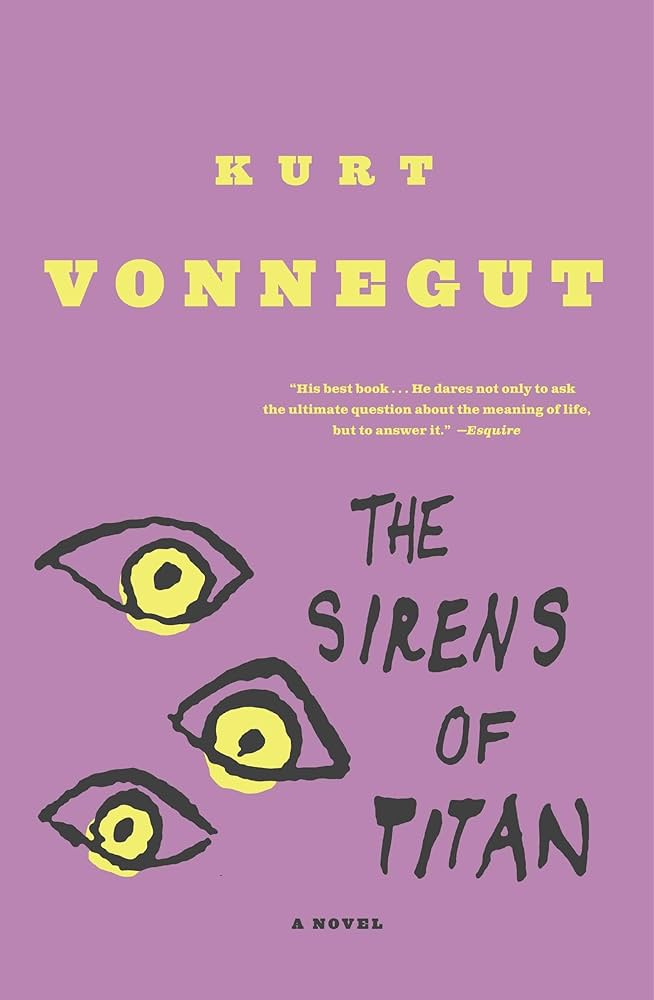
Kurt Vonnegut’s second novel.
Titan is one of the many moons of Saturn (there are at least 274 of them). Titan is the largest. It is planet-sized, bigger than Mercury, in fact. Some of the characters of this story inhabit this moon for a while when they are banished from Earth. The sirens are three rather attractive women used in an advertising campaign for Moon Mist cigarettes. Statues of them sit at the bottom of a swimming pool on Titan. So, if you get nothing else out of this piece, at least you have some idea where the odd title comes from, and that Saturn has a ridiculous number of moons.
The story starts out with Noel Constant, an unsuccessful door-to-door salesman, finding incredible luck by using the passages of the Bible’s book of Genesis to make stock picks. He simply went through each word of each sentence and used the pairs of letters that comprised it, to generate the stock symbols he should purchase. As an example- “IN.TH.EB.EG.GI.NN.IN.G”. Using this method he generated incredible wealth which he passed on to his son, Malachi, whom he only met once. During this meeting, he passed on his wealth-building method to Malachi. Malachi continued using this method after his father passed to build even more wealth, until, after five years of using this method, his luck runs out.
This sudden lack of fortune occurs just as Winston Miles Rumfoord, another extremely wealthy man, invites him to his house, through his wife, Beatrice. His wife has to make the invitation because Winston is popping in and out of existence at regular intervals throughout the universe. This is due to him crossing into a chrono-synclastic infundibulum, A chrono-synclastic infundibulum distorts space and time for the beings in it. Past, present, and future are all visible and available at the same moment. In this case Winston and his Mastiff, Kazak, are the beings trapped in this particular chrono-synclastic infundibulum.
Rumfoord manipulates Malachi, in his fragile state, as well as countless others to secretly populate Mars. This in itself does not sound too nefarious, but Rumfoord wipes the memories of his Martian populace to turn them into remote-controlled soldiers. These soldiers, with the exception of Malachi, will later be sent to attack Earth. When Malachi gets his memory wiped clean on Mars, he assumes the name of ‘Unk’ and uses this moniker for most of the rest of the story.
Unk returns to Earth after his lengthy stays on Mars and Mercury. His return occurs after the failed ‘Martian’ invasion of Earth. Rumfoord had his Martian soldiers attack Earth, despite it being a foreknown effort in futility. The attack, however, has the intended effect of uniting the people of Earth and creating a religion based on equity where Rumfoord and Malachi are a primary focus. Rumfoord is revered and powerful, while Malachi is an outcast to be shunned off to Saturn’s moon, Titan with his wife Bea (formerly Rumfoord’s wife), his son Chrono, and a robotic alien named Salo, who is waiting on a spare part for his space ship. Unk spends his remaining life, with the exception of his final day, on Titan. He dies peacefully, shortly after being dropped off by Salo, who finally received his spare part, on a park bench during a snowy night in Indiana.
This book is obviously the seed through which other books, such as The Hitchhiker’s Guide to the Galaxy series were born. This is the first absurdist science fiction space travel novel I am aware of. It also shows some of the skill Vonnegut had in transporting a reader forward and backward in time and place without confusing him. This is something that is prevalent in his later masterpiece, Slaughterhouse Five. I know of no other author who did it better. Vonnegut is also excellent at creating believable dialogue between characters, even when the dialogue may be ridiculous. This is not my favorite Vonnegut book, I preferred the story in his preceding novel, Player Piano, better, but this book shows the emerging creativity and absurdist humor that will come in his later novels.