

The author of Seabiscuit, Laura Hillenbrand, has only published two books. The other, Unbroken, was one of my all-time favorites. Both books are non-fiction and both were made into feature films. Seabiscuit was made into a better film, but Unbroken, as a film, was just ok. Despite being, in my opinion, the greatest story ever told, Unbroken was turned into a merely passable film. I hope it is remade at some point to give it the big screen telling it deserves.
Seabiscuit was a story about a racehorse, but also about a trying time in America. America, and the world for that matter, was in the Great Depression during the 1930’s. Life was tough for many. It followed the failed experiment of prohibition and other morality-based laws that oftentimes brought about an increase in amoral behavior. Organized crime boomed under alcohol prohibition and made a fortune through underground gambling ventures. As horseracing is often linked to gambling, horseracing, as a sport, was nearly absent from the United States during this time. Many Americans went South to enjoy the relaxed laws of Mexico who still served alcohol and had a world-class horseracing track just over the border in Tijuana. It was here that the paths of the main characters of Seabiscuit first converged. Jockeys John “Red” Pollard and George Woolf, stable owner Charles Howard, and trainer Tom Smith were all involved with horses and horse racing in Tijuana before it once again became mainstream in the states. Once alcohol and horse racing were allowed back in the US, Tijuana attendance dropped off dramatically.
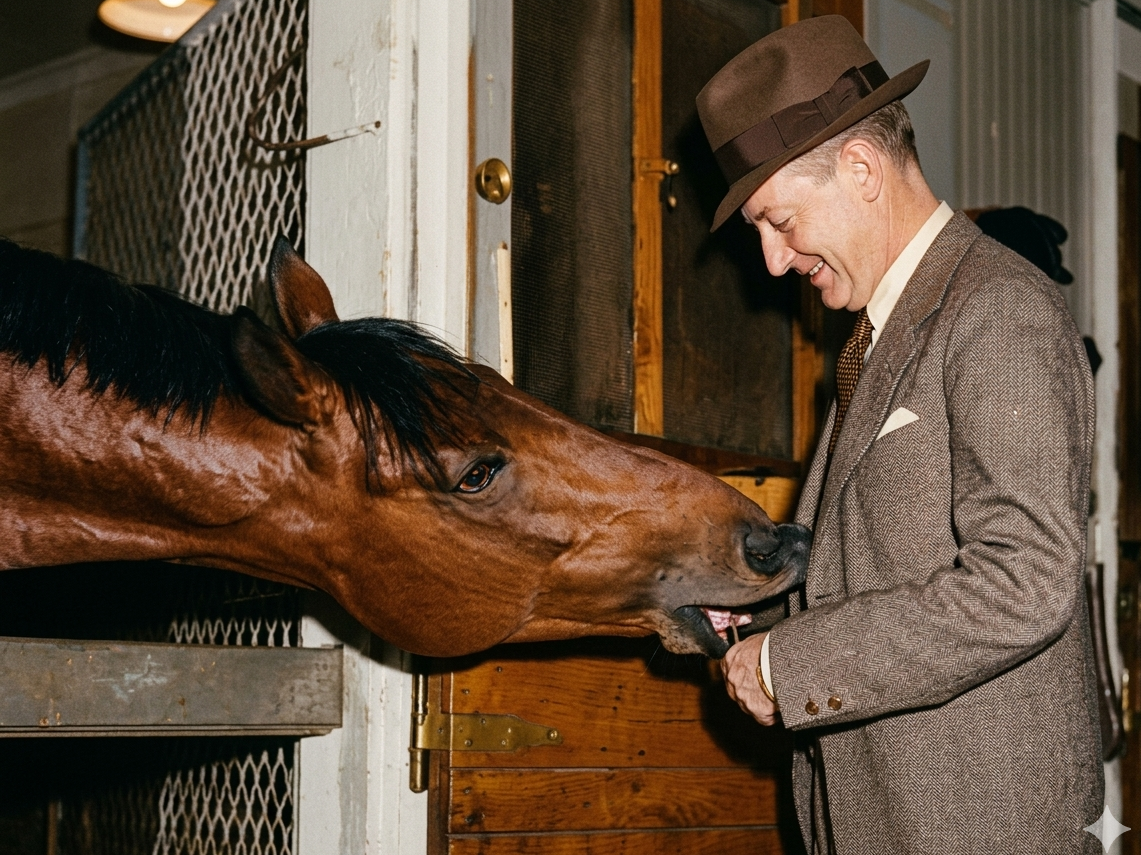
Charles Howard and Seabiscuit (colorized)
Charles Howard, the wealthy car dealer owner from California who used his fortune to finance his love of horse racing, met and hired Tom Smith as his horse trainer. This happened in Tijuana. Tom Smith then ran into Red Pollard at the Detroit Fairgrounds racetrack. Red was stranded there following an accident in the car he was traveling in and looking for work. Tom had an underperforming racehorse named Seabiscuit that needed a tough, experienced jockey that could handle the horse’s bad demeanor. Red, who jockeyed, lived in barn stalls with the horses he rode, and boxed in underground smokers to make ends meet, fit the bill.
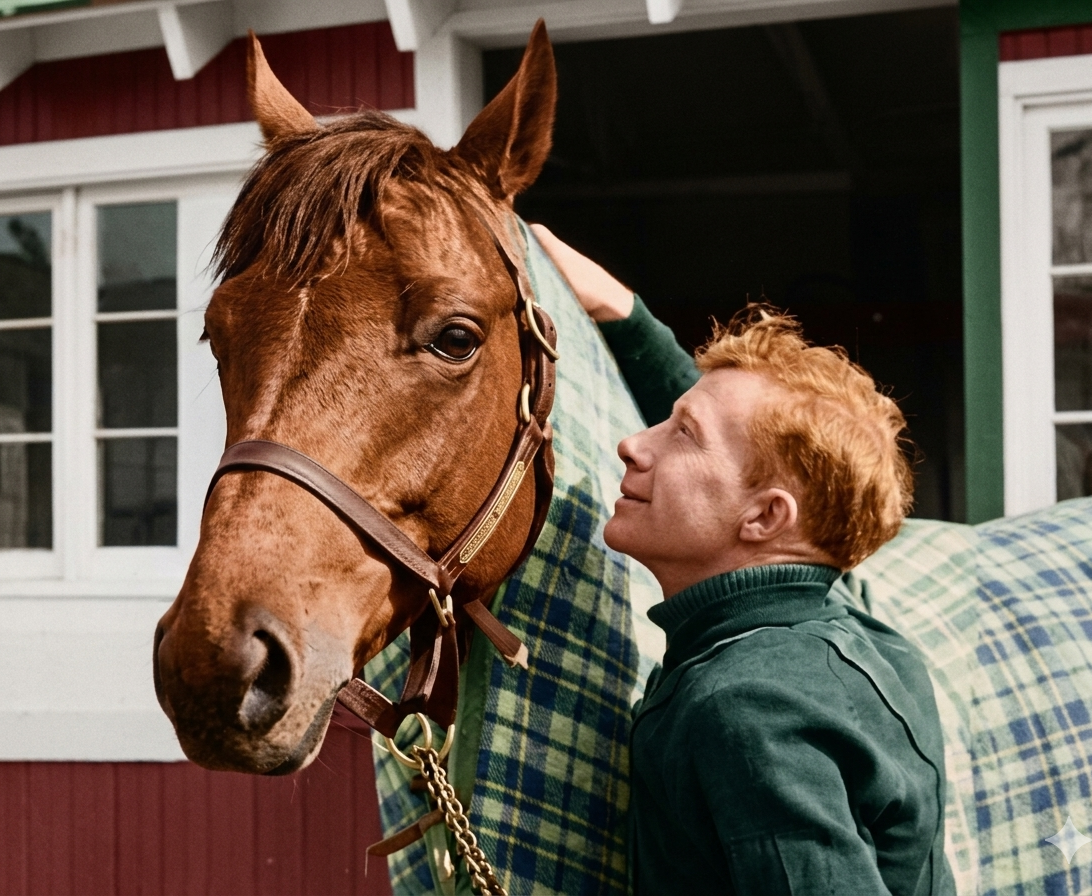
Seabiscuit and Red Pollard (colorized)
Red, however, was not your typical ruffian. He was raised in an upper-middle class family in Edmonton through his early childhood. His family owned a successful brickyard, but lost everything to a flood that wiped out the business and left the family broke. The recession followed soon after. Red’s brief upper-middle class upbringing instilled a love of reading in him and Pollard was known to quote classic literature and read voraciously in the stalls he stayed in. The combination of Tom Smith as trainer and Red as jockey began to reveal the promise in Seabiscuit. Seabiscuit was bred from a good lineage, but never proved to be much more than a middling racehorse before this point. His name Seabiscuit was just another way of saying Hard Tack. Hard Tack was his father. He was known for his great speed, but also for his troublesome demeanor, much like his son. This book reveals a great deal about the psychology of horses. Horse psychology appears to be something Tom Smith really excelled at. I was not really aware that horses can have demeanors that can turn the greatest runner a poor racehorse. According to the accounts, horses could have egos and even want to win races just as much as the jockey does. They could also express their discontent by not trying very hard in training and in races. The combination of Tom and Red seemed to figure out Seabiscuit. He wasn’t reliable at first, he would win some races easily and then loaf on others, but eventually he ran consistently enough to be considered the best horse on the West coast.
Before reading this book, I was not aware that horse racing involved a practice called handicapping. If a horse has proven to be significantly faster than the horses he is to race against, he will have additional weight placed on him to give the other horses in the field a more equal chance to prevail. The weight is the weight of the jockey plus additional weights added to the saddle. In races he was heavily favored in, Seabiscuit would sometimes carry around as much as 132 pounds and race horses carrying as little as 115.
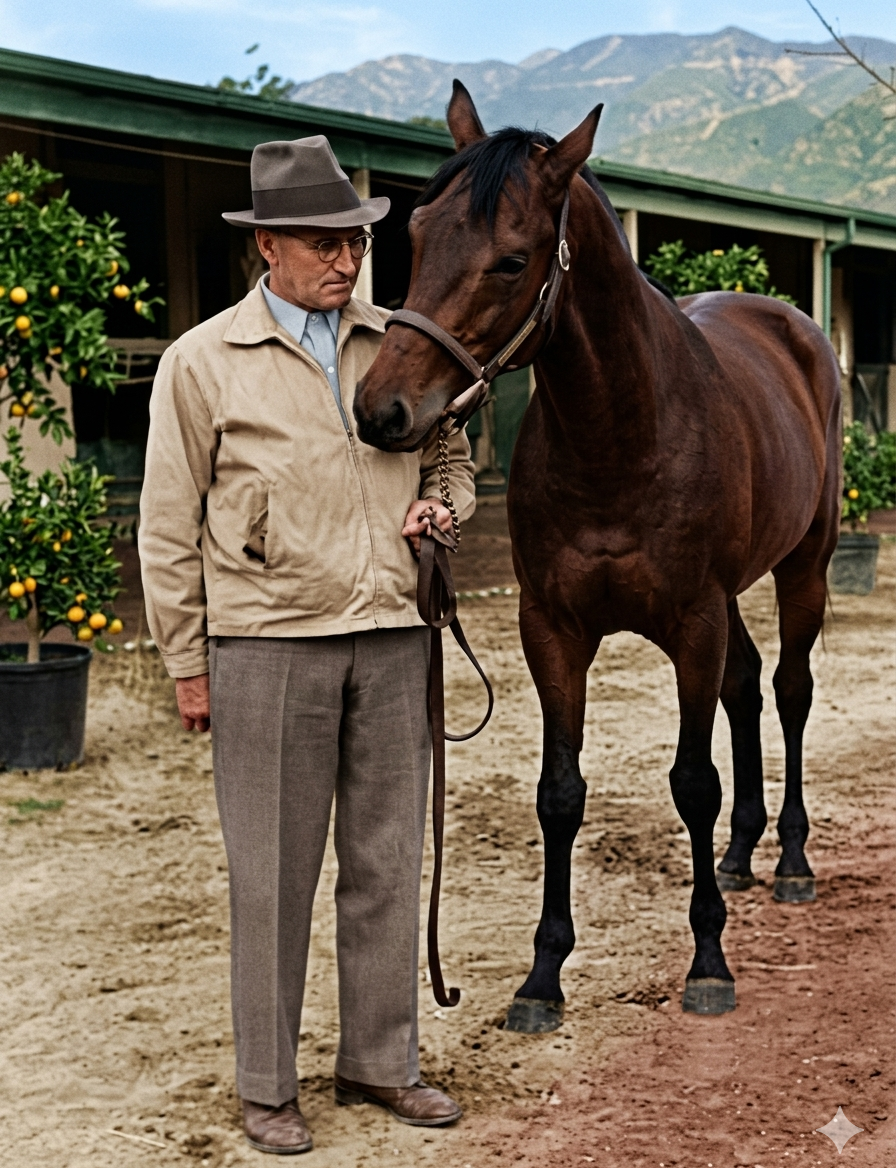
Tom Smith and Seabiscuit (colorized)
After Seabiscuit went from a middling horse to greatest on the West Coast, Seabiscuit’s owner, Howard wished to get more national recognition for his horse. There was a horse named War Admiral that dominated the East coast tracks. Howard continually worked to try and get a match race, one without any other horses, to find out who was the best. At the time, the East Coast was considered the much more elite of the two horseracing regions. War Admiral’s owner saw no reason to race Seabiscuit. To allow the race, Howard had to bring Seabiscuit to the East coast and agree to concessions that War Admiral’s owner, Mr. Riddle, imposed. They came to an agreement, but every time race day drew near, problems ensued. Once War Admiral was injured, and the next time it was Seabiscuit. Sometimes the weather was to blame. Race promoters and the media grew tired of the repeated build-up and let down. Seabiscuit returned to the West coast injured and unraced, then Pollard, Seabiscuit’s jockey was gruesomely injured in a riding accident. Seabiscuit recovered quickly, but Pollard did not. George “The Iceman” Woolf, a friend of Red’s had to fill in for the jockey duties while Pollard worked on just trying to be able to walk again. Eventually, a race between War Admiral and Seabiscuit did take place on the East coast. There were many stipulations. Both horses rode with just 116 pounds, likely just the jockey weight, they had a walk-up start, and they were to race on War Admiral’s home track, Pimlico, in Maryland. War Admiral had won 17 of his last 18 races. This is an incredibly rare feat of dominance. War Admiral was know for being a very fast starter and being somewhat unruly in a starting gate. The race was to be run with a walk-up start and no starting gate. Despite all the concessions given up by Seabiscuit’s side and despite Seabiscuit being generally viewed as the vastly inferior horse, Seabiscuit beat the best horse in the world by a fairly comfortable and decisive four lengths with jockey George Woolf. Red Pollard had to listen from his bed on the radio, along with 40 million other listeners, to one of the biggest sporting events of the era.
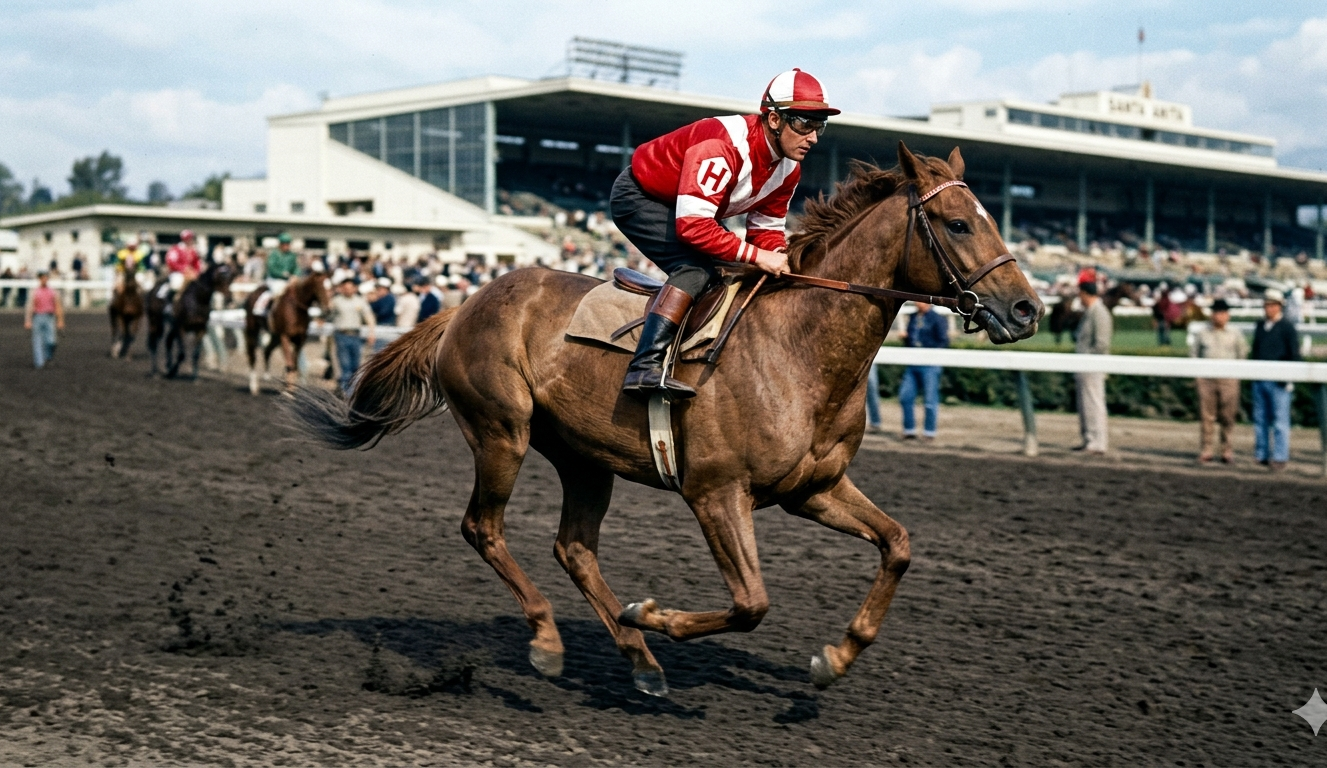
George Woolf on Seabiscuit (colorized)
Against all odds, Pollard rehabbed himself well enough to ride again. He endured several surgeries, a few of them botched, where his leg was repeatedly rebroken and re-set several times. Even after recovering, his lower leg was said to resemble a broom stick. Pollard once again raced Seabiscuit with hopes to one day win the hundred-grander at the Santa Anita track. In the ultimate underdog story, he manages the feat on Seabiscuit – a seven year-old horse. Well beyond the retirement age of most racehorses. Most are retired between age three and five and most haven’t run half as many races. In a time where most people have spent years struggling to make ends meet due to the Great Depression, most people were looking for an underdog to root for. Seabiscuit and Pollard represented the ultimate underdog duo. An aging, once discarded, middling horse ridden by a blind in one eye jockey held together by matchsticks winning the biggest stakes race of the time. A $2,000 horse with $437,730 in career winnings (in 1930’s money).
That aspect was definitely a feel good story, but Pollard retired shortly after his win, and the toil of his time as jockey caught up with him. His health never fully recovered, he suffered from alcoholism and he passed away at just 71 years old. He faded into obscurity until once again recognized by this book and subsequent film. George Woolf continued jockeying until seemingly passing out while racing, falling from his horse, and dying shortly afterwards from his injuries at just 46 years old. Another thing I learned about horse racing is that jockeys had to continually abuse their bodies to maintain low weights. Many starved themselves, purged, and used various substances to keep their weights down. Woolf was diabetic his entire career during a time where there weren’t any medications to help with this condition. Coupled with the fact that George had to keep his weight low for decades probably contributed to his falling of the horse. This is a fantastic book. Its author, Laura Hillenbrand knows how to write a page-turner. I hope she has another one in her.