

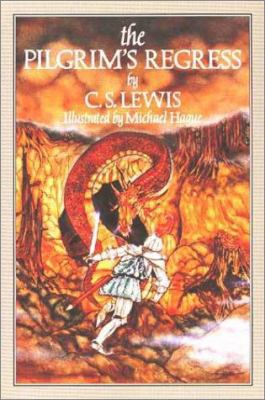
Lewis wrote this with a title that is an alteration of The Pilgrim’s Progress, a Christian allegory written by John Bunyan in 1678. In my opinion, he should have left it well enough alone. I believe much of what Lewis wrote in Mere Christianity, is what he was trying to say in this book. Unfortunately, his messages are either so cloaked in allegory that they are lost on readers, or they are so obvious, that one wonders why he chose to cover this subject in a fairytale-like adventure story?
The main character, John, always seems to be yearning to be wherever he is not. One such place is an island that appears to represent heaven. He spends most of the book traveling to reach it, only to find out it was accessible from the point from which he started his journey. He encounters dwarfs and giants in mountainous regions. He speaks of the human-like forms appearing as human in shape, but not human. I never quite understood what he was implying with this, or who these apparitions were supposed to represent. The dwarfs seem untrustworthy, but nevertheless help John in his travels by providing him food and shelter.
Throughout the story there is a reference to a landlord, who is never seen. Many believe he is real, and many believe he is a fictitious character created to control the populace through his rules. This, obviously is meant to represent God. There is also a reference to mountain apples, which the landlord does not want anyone eating. This is an obvious reference to the apple in the garden of Eden. The penalty for eating it, however is not the need for clothing, but of health that will never be what it should.
John also encounters a dragon, who has eaten all other dragons. This last remaining dragon is guarding a large treasure. How he acquired the treasure and why the dragon cares about it is not revealed. What is a dragon going to do with a bunch of gold? I was not really clear why John had to slay him. John does not acquire any of the treasure by doing so. I guess it is a triumph over sin and evil? The dragon was greedy for having eaten all the other dragons and keeping the treasure for himself? Again, what is a dragon going to do with this treasure?
In the end, John reaches the island and gets to live in the heavenly glory of the afterlife. By all means read, Mere Christianity. It is an amazing book. This one seemed to serve as a test run for it that probably should not have been released. There is even an afterward by Lewis, himself, where he very accurately critiques his writing in this one. Citing unnecessary allegory and failed character development. Give this one a pass.